

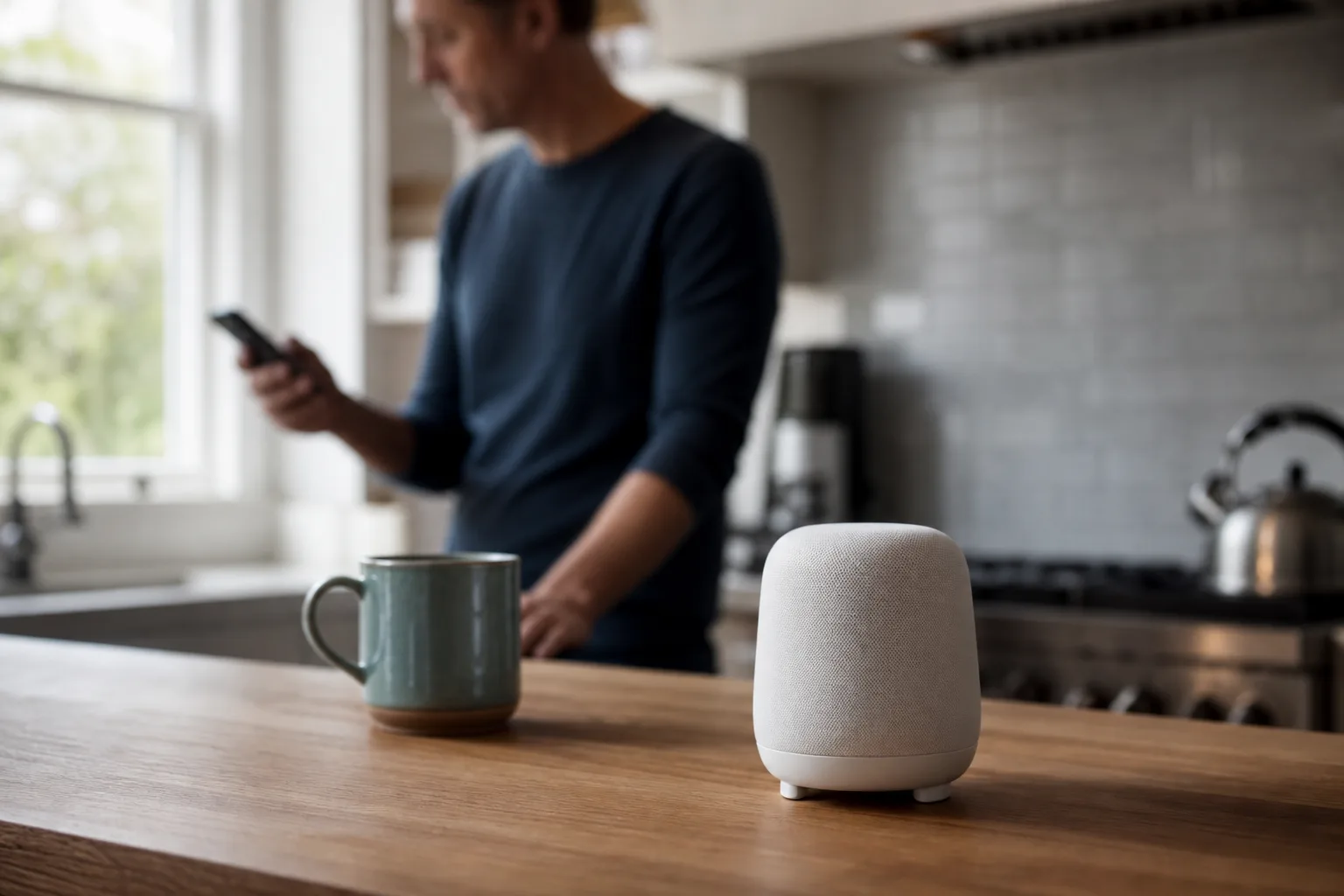
- OpenAI’s reported screenless AI speaker could move, learn user habits, and connect deeply with ChatGPT and personal digital data.
- The concept aims to make the screenless AI speaker feel warmer and more proactive than Amazon Echo or Google Nest devices ever did.
- Apple’s trade-secret lawsuit against OpenAI adds serious legal pressure to a hardware effort staffed partly by former Apple engineers.
- Consumer AI hardware has attracted enormous funding, but recent failures suggest that novelty alone will not sustain a device category.
Table of Contents
OpenAI’s screenless AI speaker is aiming for intimacy
A smart speaker that rolls or swivels toward you sounds vaguely charming until you consider what it would need to know. OpenAI is reportedly building a screenless AI speaker designed as a home companion: a physical extension of ChatGPT that can converse, develop a personality, draw on a person’s digital life and use mechanical components that move independently.
That description, reported by Bloomberg, is deliberately more ambitious than another cylindrical gadget with microphones. OpenAI has apparently been telling people internally that it wants a humanlike AI presence in the home. No public product, specification, price or launch date has been confirmed. But the outline matters because it reveals where the company thinks conversational AI is headed: away from the browser tab and toward a device that is always nearby.
My read is that OpenAI is trying to solve a very real problem with ChatGPT. The service is useful, often astonishingly so, but it remains an app people must remember to open. A successful screenless AI speaker could make the assistant feel more ambient, like asking somebody in the kitchen for help rather than pulling out a phone to compose a prompt.

That promise is also what makes this category so difficult. The closer a device gets to feeling like a household companion, the higher the standard for trust, reliability and restraint becomes. Nobody wants a synthetic roommate that invents facts, interrupts dinner, or quietly treats every conversation as training material.
The smart-speaker graveyard is a warning
Amazon and Google already spent years teaching consumers to talk to small speakers. Alexa and Google Assistant made timers, weather reports, music playback and basic smart-home controls pleasantly frictionless. Yet neither company turned that early lead into the science-fiction assistant people were promised. Alexa’s business struggled to find a durable revenue model, while Google repeatedly reorganized and rebranded its assistant strategy around generative AI.
The failure was not mainly about hardware. It was about context. Traditional voice assistants could handle rigid commands but fell apart when a request needed memory, judgment or a follow-up question. Modern large language models are much better at sustaining a conversation, which gives the reported screenless AI speaker a more plausible starting point than the Echo had in 2014.
Still, language fluency is not the same as usefulness. If OpenAI wants its device to proactively help, it has to decide when to speak and when to leave people alone. That sounds trivial, but it is the central product problem. A good assistant is like a considerate hotel concierge: available when needed, informed enough to be helpful, and never hovering by the bedside at 3 a.m.
The moving parts are an especially telling detail. Movement can make an object feel attentive without requiring a display; think of a desk lamp turning toward a speaker, or a pet cocking its head. It can also become creepy at record speed. Humane’s AI Pin and Rabbit’s R1, two high-profile attempts to establish new AI-device habits, showed that a novel form factor cannot compensate for weak practical value. And yes, remember when Google killed Stadia? Tech buyers have learned to be wary of expensive experiments backed by companies that may simply change their minds.
Why the screenless AI speaker needs access to sensitive data
Reports indicate that the screenless AI speaker may learn about its owner over time and pull from data such as email. That is where the product could become genuinely useful. An assistant that knows a flight is delayed, recognizes a calendar conflict, remembers a child’s food allergy and can draft a reply could save meaningful time.
It is also where OpenAI enters a much tougher business than chatbot subscriptions. Email, calendars, messages and home microphones are among the most sensitive sources of consumer data. The company would need exceptionally clear controls over what is connected, what is retained, what stays on-device, and how a household member can see or erase what the system knows.

OpenAI has already published consumer privacy information through its official privacy policy, but a physical household product would raise different questions. Who can grant consent in a shared apartment? Does the device recognize different voices? What happens when guests are present? And can a user meaningfully trust an AI that is designed to become more personal over months or years?
Frankly, this is where the product either earns its place or fails. The best hardware experiences often work because they remove small bits of friction. But every convenience gained by connecting another account has a cost. OpenAI cannot treat privacy settings as a legal appendix buried beneath setup screens.
Apple’s lawsuit makes the timing awkward
OpenAI’s hardware push is arriving under a particularly ugly legal cloud. Apple has sued OpenAI, alleging that the company obtained Apple trade secrets, and has said the claims presented so far are only the beginning of what may emerge in discovery. OpenAI has denied wrongdoing.
Bloomberg reports that OpenAI believes its planned device differs substantially from Apple products and is unlikely to infringe Apple trade secrets. That may prove true. Former Apple talent is everywhere in consumer electronics, and hiring experienced engineers is not evidence of misconduct. Yet a screenless AI speaker conceived with help from people who worked on major Apple products will inevitably attract scrutiny while the case proceeds.
The irony is that OpenAI may benefit from avoiding a phone altogether, at least initially. Smartphones are mature, expensive platforms with brutal expectations around cameras, batteries, apps, repairability and carrier support. A home device offers a narrower mission. It can be more experimental, and it gives OpenAI a direct relationship with users outside Apple’s App Store and Google’s Android ecosystem.
A crowded bet on an unproven category
OpenAI is hardly alone in chasing a post-smartphone interface. Brett Adcock’s AI lab Hark raised an oversubscribed $700 million Series A in May at a reported $6 billion valuation to build what it calls personal intelligence: proprietary models paired with custom hardware. The device has not been revealed, which says plenty about the sector’s current state. Money is pouring in before anyone has established the form factor people actually want.
A screenless AI speaker may be a more sensible first move than a wearable because it can stay plugged in, house stronger microphones and speakers, and live in the place where routines repeat. But it must do more than chat elegantly. It needs to be dependable enough for calendars and home tasks, private enough for families, and useful enough that people keep it on the counter after the novelty wears off.
OpenAI has the one advantage every new AI-device maker wants: ChatGPT is already a household name. The hard part is turning that name into a household object without making the home feel like another data collection point. If the company gets that balance right, the speaker could matter. If it does not, it will join a long list of clever devices that consumers admired from a distance.

